
Chapter 1
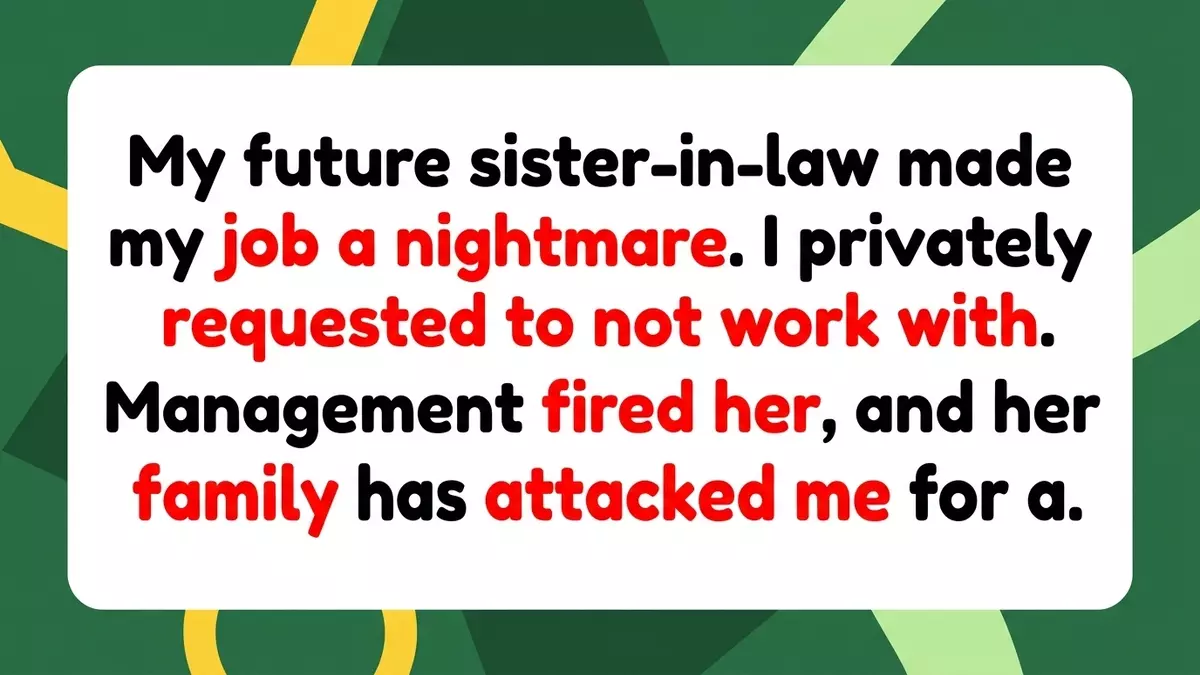
Office Drama Sparks Year-Long Feud For Future In-Laws
Navigating the delicate boundary between professional life and family relationships is like walking a tightrope over a burning bridge. When these two distinct worlds collide, the consequences can jeopardize not only your hard-earned career but also the foundational peace of your personal life. For one 31-year-old woman, this theoretical boundary-crossing nightmare became a harsh reality when her future sister-in-law was hired into her tight-knit office environment. While blending business with family is universally recognized as a massive gamble, nobody could have predicted just how rapidly this workplace experiment would implode, leaving a trail of deep-seated resentment in its wake.
What began as an opportunity for collaboration quickly deteriorated into a toxic environment. Within a mere three months, the workplace transformed into a psychological minefield characterized by constant operational errors, aggressive defensive outbursts, and deeply uncomfortable team confrontations. The situation eventually forced a critical choice between professional survival and familial compliance, igniting a year of intense family drama that continues to burn brightly with no resolution in sight.
Office Drama Sparks Year-Long Feud For Future In-Laws
The Danger Zone: When Family Dynamics Enter the Cubicle
Mixing corporate hierarchies with personal relationships changes the operational chemistry of any office. In a standard corporate setting, professional boundaries are maintained through established protocols, mutual respect, and objective performance metrics. However, when a relative enters the equation, these structured boundaries frequently dissolve, replaced by unspoken expectations of unconditional loyalty and preferential treatment.
In this particular case, the introduction of the future sister-in-law into a highly cooperative, close-knit team immediately altered the office equilibrium. Instead of maintaining a clear separation between her personal identity and her professional responsibilities, the new hire carried familial expectations into her daily tasks. When personal relationships bleed into corporate workflows, minor misunderstandings or standard corrections are rarely viewed objectively. Instead, they are interpreted through an emotional lens, turning routine quality-control checks into deeply personal battlegrounds.
Three Months of Chaos: The Breakdown of Professionalism
The structural cracks in this arrangement appeared almost immediately. Within the first ninety days of her employment, the future sister-in-law struggled consistently with foundational tasks essential to her role. In any standard onboarding process, mistakes are expected, provided the employee demonstrates a willingness to learn, accept feedback, and adjust their methodology.
Unfortunately, a complete refusal to take accountability characterized the new hire's approach. Rather than embracing constructive guidance from seasoned team members, she met every piece of corrective feedback with intense hostility and defensive posturing. This frustration was not distributed evenly; it was targeted primarily at her future sister-in-law. The office environment quickly devolved into a stressful ecosystem where coworkers had to tiptoe around her volatile ego to prevent public outbursts. The systemic errors continued to mount, directly threatening the entire department's productivity and accuracy metrics.
The Tipping Point: A Quiet Request with Loud Consequences
The breaking point arrived after a sequence of escalating workplace confrontations, culminating in a highly condescending and public remark directed at the original poster. Recognizing that her own professional standing, mental well-being, and daily productivity were being severely compromised, the 31-year-old professional realized that private intervention was no longer viable.
"Protecting your career and peace of mind should not have to come at the cost of your family dynamics, but real-world boundaries often demand tough choices."
To protect her workspace and preserve her sanity, she scheduled a private, confidential meeting with her direct manager. During this discussion, she made a measured, objective request to be uncoupled from her relative's projects, citing the ongoing friction and its measurable impact on her workflow. She did not demand termination; she simply requested structural distance to perform her job duties effectively.
However, management operates on numbers, liability, and overall team performance. The manager, already acutely aware of the new hire's recurring performance deficits and volatile attitude, used this conversation as the final catalyst. Recognizing that the new employee was a liability to team cohesion and operational output, leadership made the unilateral business decision to terminate her employment immediately.
The Psychological Reality: Defensiveness and Shifting Blame
The explosive fallout from the termination provides an excellent case study in workplace psychology, particularly regarding how individuals process professional failure. Behavioral experts note that when individuals exhibit extreme defensiveness in the face of constructive criticism, it is often a subconscious defense mechanism designed to shield a fragile self-esteem. Admitting to professional shortcomings requires a level of vulnerability that some find entirely intolerable.
To avoid the painful reality of her own incompetence, the sister-in-law utilized what psychologists term an external locus of control. Individuals with this mindset believe that external forces—rather than their own actions—determine their life outcomes.
Ego Preservation and Scapegoating
By convincing herself and the broader family network that she was the victim of a calculated corporate betrayal, the sister-in-law successfully preserved her ego. She framed the situation not as a failure to meet basic job requirements, but as a malicious personal vendetta orchestrated by her brother's partner. This projection allowed her to avoid the internal discomfort of accountability, transforming her from an underperforming employee into an aggrieved victim in the eyes of her relatives.